
How Cassatt Warms a Room
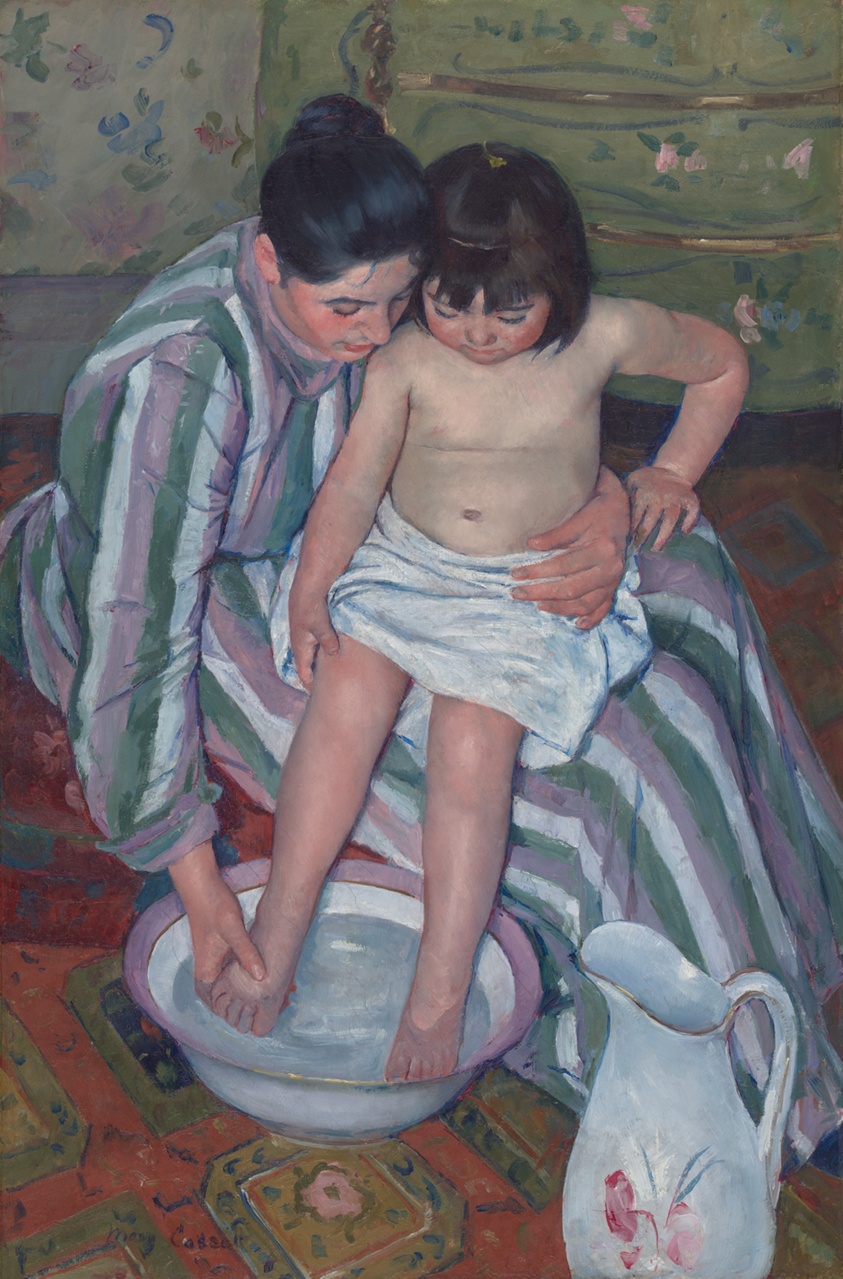
The Child's Bath looks like a tender domestic scene, and it is, but the tenderness is constructed rather than found. More than eighty percent of the surface is cool gray-violet neutral. The only true warmth sits on skin: the mother's hand and forearm, the child's bare body. Everything around them is flat decorative pattern, the striped dress, the floral wall, the tiled floor, lifted from Japanese prints.

The warmth is all skin
Read the proportional palette and the painting looks like it should feel cold. Gray-violet neutrals own better than eighty percent of the surface. They do not feel cold, because the little warmth there is sits in the right places. The mother's hand on the child's waist, the forearm, the small rounded body: these are the only fully saturated passages in the picture, and they are all flesh. The warmth never spreads. It stays exactly where a body is.
What makes it intimate is scale. Cassatt runs her warm-against-cool contrast across inches, not across a room. The child's warm cheek meets the cool stripe of the mother's shoulder. The bare leg hangs into lavender-gray water. You feel the closeness because the temperatures are that close together, touching, the way warmth actually passes between two people leaning into each other.
What she took from Japan
In 1890 a large exhibition of Japanese woodblock prints opened in Paris, and Cassatt went back to it again and again. Utamaro's prints of a mother bathing her child were among the works that struck her, and within a year she had made her own set of ten color prints in answer to them. The first thing she borrowed was the shape: a tall, upright, vertical format like a Japanese print, with the long straight limbs of the mother and child running the height of it. Then the high vantage, looking down into the scene, and the flatness: the striped dress, the floral wall, the tiled floor all pressed into flat decorative pattern.
One object refuses the scheme. From this height we look straight down into the basin, the water lying open as a wide ellipse, exactly as the viewpoint promises. The white pitcher in the corner does not obey. It stands upright and close, seen from the side at eye level, a second viewpoint smuggled into the same frame. Cassatt lets the contradiction stand, the way she lets the patterned room stay flat while the bodies inside it round.
The dark that ties them together
The painting is mid-key and soft, so the few true darks carry real weight, and the darkest note in it is hair. The mother's head and the child's head lean together until their dark hair merges into a single black shape at the top of the canvas. Before the shared task at the basin, before anything else, the two are already joined there, in the one deep note the picture allows itself.
That flat, punctuated black is Japanese as well. The woodblock prints treat black as structure, a mass of hair, a band of a robe, not as shadow to be modeled. Pattern flattens, flesh rounds, and a single knot of dark hair binds the two figures at the top of the frame.
ArtSensei helps you put warmth exactly where it belongs in your own work, one passage at a time.
Try ArtSenseiCommon questions
What did Cassatt take from Japanese prints?
The tall vertical format, the high seeing-from-above viewpoint, flat areas of unmodulated color, simplified outline, and decorative pattern. She drew especially on Utamaro's prints of a mother bathing a child, shown at the 1890 exhibition of Japanese prints in Paris, and answered them with her own series of ten color prints in 1890 and 1891.
Are the mother and child Cassatt's own family?
No. Cassatt had no children and worked from hired models and people around her. The picture is a constructed image of maternal intimacy, a motif she returned to often, not a family portrait.
Where can I see The Child's Bath?
The Art Institute of Chicago, permanent collection. Painted in 1893, now public domain.